

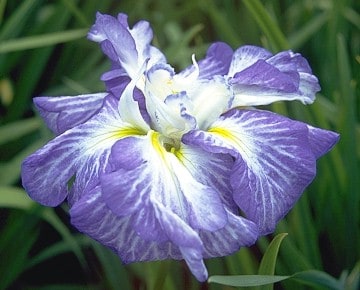
Reproduced with permission from Ensata Gardens, Galesburg, Michigan
No other iris is influenced to as great a degree by culture as are the Japanese Iris (JI). Good culture will increase height, branching, flower size and quantity of bloom. No other factor will be greater influence than water and its quality (pH and or salts) A lack of moisture will stunt the plants and produce miniature blooms. An abundance of water and manure can produce four to five foot tall bloom stalks! JI need six hours of full sun to bloom properly.

JI requires ample moisture, especially up to bloom time, and you will be rewarded with much healthier plants and bloom next year if the plants are kept watered all summer long. We want to say wet in spring and moist the rest of the year. Never let the soil dry out; mulch the plantings.
Depending on your soil, 1-2 inches of water and or rain per week is recommended; older clumps will need more water than new divisions. They do very well near water or where the water table is a short distance below the surface, as beside a stream or pond.
Location and Soil for Japanese Irises
Probably the largest misconception that JI are bog or water plants comes from photos of flooded fields of Japanese Irises in bloom in Japan. The Japanese flood the fields at bloom time for the esthetic setting and the beauty of the blooms reflected in the water.
Japanese irises are not bog plants in northern zones (zones 3-6) mainly due to the fact that if water freezes over the top of the crowns the plants may suffocate and die. Artificial, plastic lined bogs have produced mixed results with some becoming saturated with water and souring and suffocating the roots. It is best to put some holes in the bottom and allow the plastic lined bogs to retard drainage but not prevent it.
Some people do raise JI in pots in their ponds but the pots should be lifted after frost, the foliage cut off and the pots buried in the garden. The pots may be returned to the pond the next spring. Use large enough pots and weight to keep the 3-4 foot plants from blowing over in winds.
Japanese irises prefer a rich soil with ample organic matter to help in water retention as well as adding nutrients. The soil pH should be slightly acid (5.0 to 6.5). Attention must be given to the pH of your irrigation water, which can gradually raise the pH of your soil. An indication of too high pH is the gradual yellowing of the leaves. The soil pH can be lowered by the addition of granular ferrous sulphate (iron sulphate) or agricultural sulphur. Do not use mushroom compost as it contains lime.

Japanese irises are heavy feeders. Depending on your soil, a liberal application of fertilizer in spring and just before or after bloom is beneficial. Most soils need more nitrogen and JI like nitrogen.
Water-soluble acid fertilizer, such as Miracid is good for quick action but only lasts for 2-3 weeks. The preparation of your iris bed with compost or manure will be a good start for your JI but do not use granular fertilizer until they are established.
Planting of Japanese Irises
Here are the important steps of planting of JI:
- Be careful not to let your plants dry out after fertilizing as this will quickly burn plant roots.
- Virgin soil (virgin to JI) will produce your best plants.
- Try not to replant JI divisions back in the same soil where JI have grown for three or more years.
- Plant divisions 12-18 inches apart; 18-24 inches if you don’t want them crowded in three years.
- The rhizome should be planted 2-3 inches deep.
- You can plant them in a depression that will help catch and hold more water.
- Fill the depression with mulch.
New roots form above the old roots each year, by the time the crown grows to the surface and the roots can be seen, it is time to dig and divide the plant. Plants under good culture require division every 3-4 years. Your best bloom will be on 2 and 3 year old clumps. When bloom size or plant height decline – divide.
Japanese iris can be transplanted almost anytime from spring until fall if you can keep the transplants wet for the rest of the year and the temperatures are below 90 F for a month afterwards. The best time for you is a combination of your climate and your gardening practices. Early spring to right after bloom is the best time for us. Hot and or dryer regions may have better luck with fall planting (cooler and moist).
Dividing and Replanting JI
Japanese iris can be transplanted almost anytime from spring until fall if you can keep the transplants wet for the rest of the year and the temperatures are below 90 F for a month afterwards. The best time for you is a combination of your climate and your gardening practices. Early spring to right after bloom is the best time for us. Hot and or dryer regions may have better luck with fall planting (cooler and moist).
When dividing, cut back ¾ of the foliage and plant 2-4 fan divisions. Keep the transplants well watered until they are well established. Of course we recommend keeping them well watered all year! DO NOT let the rhizomes or the roots dry out during transplanting: soak in a bucket of water up to 48 hours.
We recommend heavy mulching year round: 2-3 inches. The mulch helps to conserve moisture, keep the soil cooler and reduce heaving of fall transplants. Remove the old foliage after the first frosts. Destroy the old foliage which may contain borer eggs or foliage thrips. The two main pests of JI can be controlled, where warranted with systemic insecticides. We use Cygon 2E or Isotox. Discuss this topic with other gardeners in your local iris club.
Iris flowers are generally identified by a structure of three upright “standards” and three lower segments known as the “falls”. Japanese irises are of the beardless category.
Find out more: To learn more about irises and how to care for them, join the Canadian Iris Society (CIS).
Visit the website of Ensata Gardens in Michigan USA. They are the largest specialists in Japanese Iris in North America… and they are nice guys too! www.ensata.com
You may also wish to visit the web page of the SJI – Society for Japanese Irises Learn more about these beautiful plants. SJI is a section of The American Iris Society and foster the culture, appreciation, breeding and distribution of hybrids of Iris ensata – commonly known as Japanese Irises
 Hello everyone! We are a society of iris lovers. Growing different kinds of irises – is our all-time favorite hobby. In our blog, you find detailed information about iris flower cultivation and fertilization. We will show you that gardening can be interesting and fun!